
There’s been a lot of rhetoric surrounding NV GEBE lately however often it feels as though we are stuck in a kind of limbo. Despite this, I remain hopeful that whatever roadblocks stand in our way will soon be cleared, and that as a nation we can once again start moving toward a brighter future. In fact, I am committed to helping make that a reality. In this three part series I want to outline a vision for Sint Maarten’s energy and financial future. The solution is staring us in the face, and the benefits can reach far beyond just keeping the lights on. It is a journey that takes us from the reality of blackouts and high bills to a future where abundant clean energy helps us fight inflation and build real wealth on the island.
Part 1: Energy Security
The first step is energy security. For Sint Maarten, the top priority should be achieving a grid that runs at least 99.9% of the time while also bringing down the cost per kilowatt hour. Getting more generators may help with reliability, but it leaves us at the mercy of global oil prices. That makes stability possible, but affordability out of reach. To be clear, diesel generators will remain necessary for years to come, so if new ones have been ordered that money is not wasted. But when it comes to cost reduction there is only one viable path, and that is solar power.
This isn’t just me calling from the rooftop. There is a well-recognized way to measure the true cost of electricity production called the Levelized Cost of Energy, or LCOE. It calculates how much one kilowatt hour costs over the lifetime of a system. With Salomon Solar Services we have achieved an LCOE of about 12 cents per kilowatt hour for customers. Compare that to GEBE’s roughly 35 cents, and you are looking at electricity for about a third of the price. Put differently, solar delivers power at a 67% lower cost. These numbers come from residential systems, and at larger scales the cost can fall even further thanks to economies of scale.
So the challenge is not proving solar is cheaper. The real challenge is bringing it to Sint Maarten in a way that integrates sustainably into the grid. Other countries have already made this transition, and their experience shows that the key is pairing solar with battery storage. The sun does not always shine at the same intensity and solar output fluctuates with radiance. Batteries are now affordable enough to act as stabilizers, forming the backbone that smooths supply and makes solar reliable as a primary power source rather than just a supplement.
Of course, the next question is how to finance such a transition. Here too there are clear opportunities. The Netherlands recently earmarked 150 million euros in the SDE++ program, with more than 33 million specifically allocated for Sint Maarten. The Access to Energy Fund (AEF) also offers loans of up to 10 million euros for renewable projects in developing countries. These funds mean we do not need to carry the full burden ourselves, and the savings from cheaper solar energy can in turn help repay any loans that are taken.
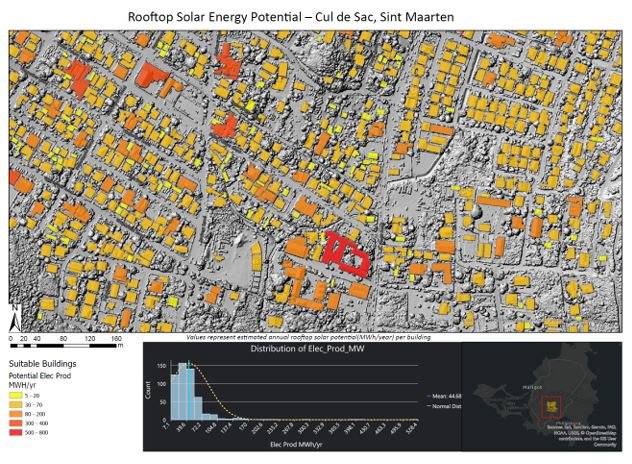
Another stumbling block often raised is space. It is true that Sint Maarten currently lacks the land for a massive solar farm. But that misses the point that we have a huge amount of unused rooftop space. Recently, I partnered with Johann Sidial a consultant who was involved in the island’s GIS mapping, and together we have been refining the models using real-world data. The image included here shows the solar potential of rooftops in a section of Cul de Sac. In this one area alone there are 1,658 roofs. If each hosted just 20 panels (a realistic conservative average) the combined output would amount to a solar “park” of 14.6
megawatt, generating about 65.7 megawatt hours per day. That equates to roughly 6.5% of GEBE’s daily production. The solution is out there, but we need to be creative enough to see it.
A practical way forward would be to start with the GEBE plant and water production facilities. The land now used for leased container generators could eventually hold containerized battery units instead. Over time, schools, government buildings, warehouses, and other large structures can be fitted with panels. Neighborhood-level batteries can be deployed to stabilize supply locally. As the grid becomes stronger, we can expand into residential leasing and net metering so households that generate excess electricity feed it back, driving down the marginal cost of every additional unit consumed.
This is the foundation Sint Maarten must build. Energy security is not just about convenience or lower bills. It is about freedom. Freedom from blackouts, freedom from volatile oil markets, and freedom to plan a future in which energy is more than a utility. It becomes a source of strength and prosperity. In the next part of this series I will explore what happens when we move beyond security and reach the stage of energy abundance. Spoiler: it does not just lower bills, it can actually make our money worth more!